Primal Grow Pro Official Website › Blog › The Ingredient Half The Artwork Omits
The Ingredient Half This Artwork Leaves Out
This seller publishes two ingredient graphics. One of them names St. John’s wort and the other does not, so half the people who look up what is in the formula never learn that it contains the most interaction-prone botanical in common retail sale. This is what that ingredient does, which medicines it reaches, and why an omission in a marketing graphic is worth more than a footnote.
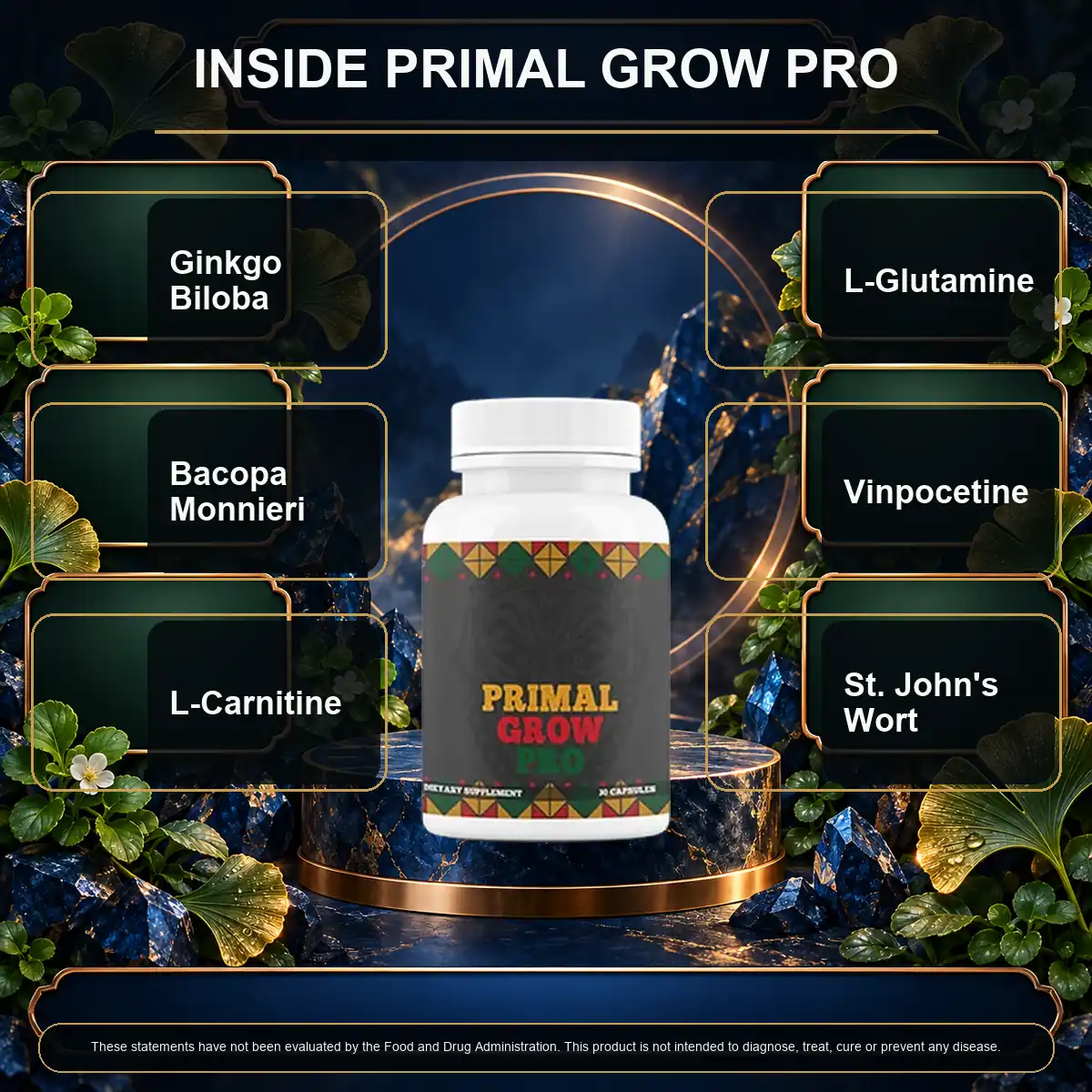
- Of the seller's two ingredient graphics, only one names St. John's wort.
- St. John's wort activates the pregnane X receptor and induces CYP3A4 and P-glycoprotein, two of the body's main routes for clearing drugs.
- The result is that certain prescription medicines are cleared faster and reach lower blood levels than the prescriber calculated for.
- The documented list includes hormonal contraceptives, transplant medicines, antiretrovirals, digoxin, anticoagulants, statins and several psychotropics.
- The effect takes days to build and days to fade, so starting and stopping is not a way around it.
- One sentence to whoever writes your prescriptions settles it.
One formula, two lists, one missing name
A buyer who wants to know what is in this capsule has two documents to look at, and they do not agree with each other.
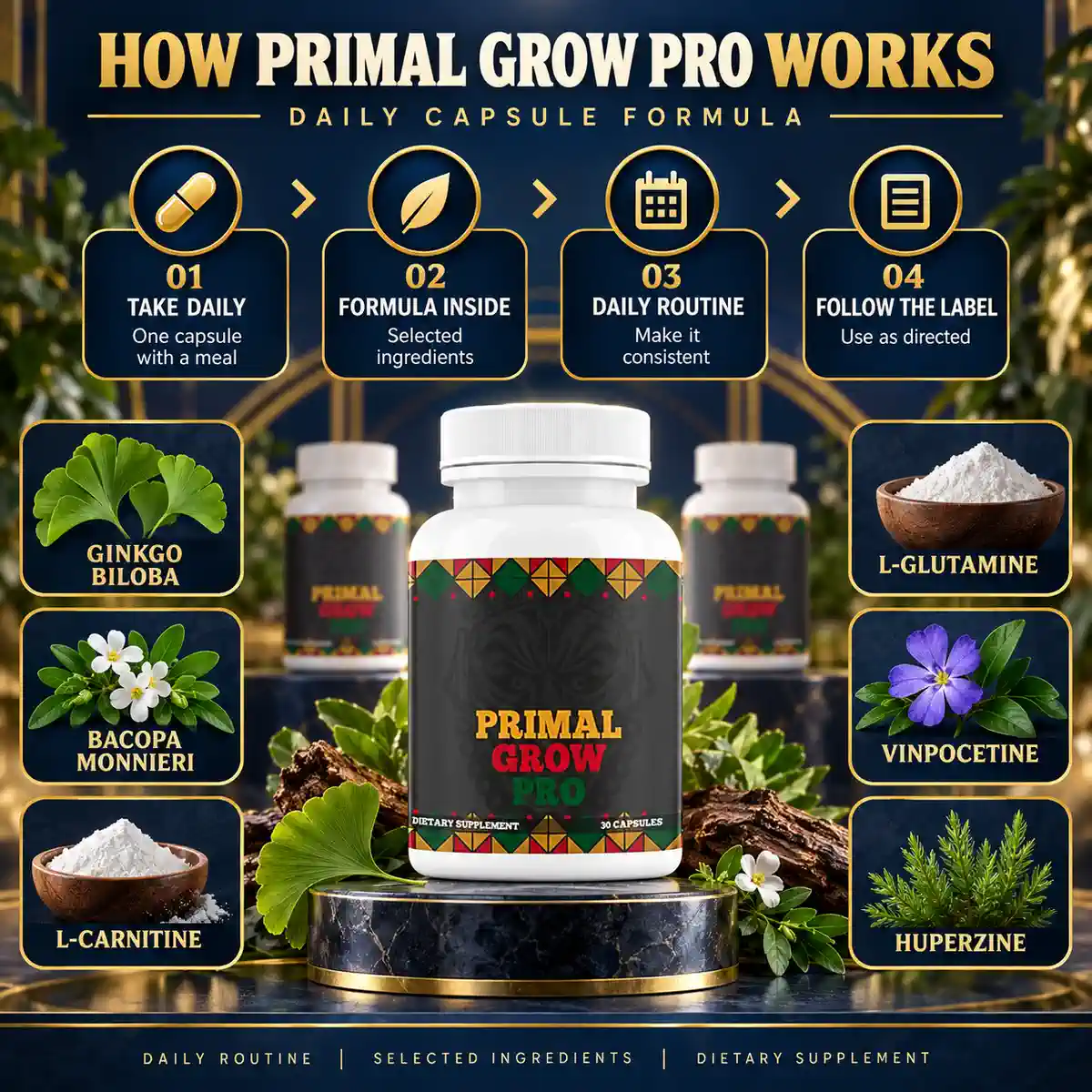
The graphic headed INSIDE PRIMAL GROW PRO names six botanicals and includes St. John’s wort. The graphic headed HOW PRIMAL GROW PRO WORKS names six botanicals and leaves it out, substituting huperzine. Their union is seven, and neither on its own is the complete list.
Most buyers see one of the two, and in one case the missing name is the one with the most to say about whether the product is safe alongside a prescription.
The rest of this article is about that ingredient: what it does, which medicines it reaches, and why this omission matters more than a missing amount would.
What the plant is, and where its research sits
Hypericum perforatum is a yellow-flowered European plant whose flowering tops are dried and extracted. Its research base is in depression, at 900 mg a day of standardised extract given as 300 mg three times daily, and the reviews of it are mixed.
What St. John’s wort brings to a combination is mood, which is a legitimate thing to want and not what most buyers think they are purchasing. It also brings the interaction profile, and the two travel together: the constituents behind the antidepressant signal are the constituents behind the enzyme induction.
On its own, in somebody taking nothing
The NIH LiverTox monograph records the ordinary complaints: mild gastrointestinal upset, dizziness, dry mouth and photosensitivity. Serious liver injury is very rare, and in somebody on no medication this is a reasonably well tolerated botanical.
What it does inside the body, in plain words
Two systems do most of the work of clearing drugs. CYP3A4 is an enzyme in the liver and the gut wall that modifies a large share of prescription medicines; P-glycoprotein is a transporter that pumps compounds back out of cells, including out of the gut lining before they are absorbed.
St. John’s wort activates the pregnane X receptor, which acts as a master switch for both. Turn it up and medicines handled by either route are cleared faster and absorbed less.
The 2020 clinical review in the British Journal of Pharmacology is the current summary of which combinations matter in practice and which are theoretical.
The direction is the part to hold on to. This is an interaction that produces LESS drug, not more, which shapes everything about how it presents.
The medicines that matter
| Medicine group | What happens | Why it matters |
|---|---|---|
| Hormonal contraceptives | Blood levels of the hormones fall. Breakthrough bleeding is the visible sign and is not always present. | The failure mode is silent, and the person affected is often not the person taking the capsule. |
| Ciclosporin and tacrolimus | Levels fall, which in a transplant patient is a rejection risk rather than an inconvenience. | This is the interaction with the most serious documented consequences. |
| Antiretrovirals | Drug exposure falls through the same enzyme and transporter route. | Reduced exposure in this setting is a treatment-failure risk. |
| Digoxin | Levels fall, through P-glycoprotein rather than through the enzyme system. | Digoxin has a narrow therapeutic window, so a modest change matters more than usual. |
| Warfarin and other anticoagulants | Anticoagulant effect is altered. Case reports run in both directions depending on the agent. | Either direction is a problem: too little means clotting risk, too much means bleeding. |
| Statins | Several are cleared by CYP3A4, so their levels fall. | A cholesterol medicine quietly working less well produces no symptom at all. |
| Serotonergic antidepressants | The concern here is additive rather than metabolic. | Different mechanism, same conclusion: a conversation with a prescriber. |
Seven groups drawn from the 2020 clinical review. The list is not exhaustive; its purpose is to show the size and the shape of the problem.
The breadth is the point rather than any single entry. Hormonal contraceptives and statins are among the most widely prescribed classes in the world.
A broader systematic review of herb-drug interactions puts St. John’s wort at the head of its own table for the same reason: more documented, clinically relevant interactions than any other botanical in retail sale.
The contraceptive interaction in detail
This one deserves its own section because it is the most common and the most easily missed.
A randomised controlled trial in women taking a low-dose oral contraceptive gave St. John’s wort alongside it and measured what happened. Hormone levels were altered and breakthrough bleeding increased. A later systematic review collected the wider evidence and reached the same conclusion.
Two features make it worth singling out. Breakthrough bleeding is the visible sign and it is not always present, so its absence is not reassurance. And in a formula sold to men, the person whose contraception is affected is not the person taking the capsule. Supplements sit in shared cupboards, which makes this a question worth asking at the point of purchase rather than at the point of sharing.
Anticoagulants, and why ginkgo joins the conversation
Anticoagulants appear on the list for the enzyme reason, and they bring a second ingredient into the discussion. A systematic review of warfarin interactions with food, herbs and supplements collects the case reports, and both St. John’s wort and ginkgo appear in it.
The two are there for different reasons and with different strengths of evidence. St. John’s wort alters warfarin’s clearance through a well-characterised mechanism. Ginkgo’s association with bleeding rests on case reports and on a plausible effect on platelet activating factor, and the reviews of it are markedly more cautious.
For a buyer the distinction matters less than it looks, because the action is the same either way. Anybody on an anticoagulant or a platelet inhibitor should tell the clinic that manages it. Those clinics have this conversation weekly.
Read the whole Primal Grow Pro ingredient list before deciding
Seven named botanicals, one capsule a day with a meal, and 60 days from the date of purchase if the answer to the prescription question turns out to be no.
From $49 a bottle · $69 for a single month · 60-day money-back guarantee
Order Primal Grow Pro On The Official WebsiteLot PRI-26/PR-6751 · 30 capsules · taken once daily with food
How the effect behaves over days and weeks
Enzyme induction is not a switch. The body has to manufacture more enzyme and more transporter, which takes time, and it has to stop manufacturing them and let the existing supply turn over, which also takes time.
In practice the effect builds over roughly one to two weeks of regular use and fades over a similar period. A first week without incident therefore proves nothing, and skipping the capsule on the day of an important dose achieves nothing at all: what has changed is enzyme capacity rather than anything circulating that morning.
Stopping is a real intervention with its own timing too. Medicine levels rise back toward normal over a fortnight, which for a narrow-window medicine is worth mentioning to a prescriber.
Why this one is easy to miss
| What people assume | What is actually the case |
|---|---|
| The risk is an overdose of the herb. | The risk is that a prescription medicine reaches a lower level than intended. |
| A small amount is automatically safe. | Nobody outside a manufacturer can tell how much is in an unquantified capsule, in either direction. |
| Stopping for a few days before a dose of medicine solves it. | Enzyme induction takes days to build and days to wear off, so short gaps do not reset it. |
| A new symptom is how you would notice. | The commonest sign is the absence of a symptom that a medicine had been preventing. |
| Telling a prescriber is awkward. | It takes one sentence and it is the single most useful thing on this page. |
Five assumptions worth correcting, and the last one is what stops people acting on the other four.
That table is the argument of this post compressed. The fourth row is the one that catches people: the commonest presentation of this interaction is nothing happening.
A contraceptive works less well and nobody notices until it has failed. A statin working less well produces no sensation at all. Neither looks like a supplement side effect, and neither would be reported as one.
Why combination formulas hide it
A single-ingredient St. John’s wort product announces itself, and any pharmacy will flag it. A combination formula is different: seven names on a graphic, one of them St. John’s wort, in a category that has nothing to do with mood. A buyer who wanted a vitality capsule is not primed to check an interaction list, and the ingredients page here prints both vendor lists side by side for that reason.
The lesson transfers to any combination product in any category. Read every name on the list, not the ones the marketing emphasises, and look the unfamiliar ones up before the first capsule rather than after the third week.
The conversation, in one sentence
Everything above reduces to a single practical action, and it is a short one.
- Write down every name on the ingredient list. Seven takes thirty seconds.
- Take that list to whoever writes your prescriptions, or to the pharmacy that fills them.
- Ask one question: does anything I take interact with St. John’s wort or ginkgo?
- If the answer is no, you have removed the largest complication in the purchase.
- If the answer is yes, you have avoided a problem that would have been invisible.
- Either way it took one exchange and it is the best-value minute in this entire subject.
The alternative is a page mentioning a consultation in every paragraph until the advice means nothing. Naming the interaction once, with the list attached, is more use.
What this is not
This is not a claim that St. John’s wort is dangerous. In somebody on no medication it is among the better tolerated botanicals in retail sale.
Nor is it a claim about a particular product. Interaction risk depends on how much is present, and a product publishing no amount cannot be placed on that scale from outside. That cuts both ways.
And it is not a reason to avoid combination formulas. It is a reason to read all of the names on one, including the ones a graphic leaves off.
Raise St. John’s wort with whoever wrote it before the first capsule. The interaction is well characterised, the conversation is short, and the failure mode is a medicine quietly working less well rather than a symptom you would notice. Who it is for sets out the six situations where this formula is the wrong answer.
References
- Nicolussi S, Drewe J, Butterweck V, et al. Clinical relevance of St. John's wort drug interactions revisited. Br J Pharmacol. 2020;177(6):1212-1226. PMID 31742659. https://pubmed.ncbi.nlm.nih.gov/31742659/
- Berry-Bibee EN, Kim MJ, Tepper NK, et al. Co-administration of St. John's wort and hormonal contraceptives: a systematic review. Contraception. 2016;94(6):668-677. PMID 27444983. https://pubmed.ncbi.nlm.nih.gov/27444983/
- Pfrunder A, Schiesser M, Gerber S, et al. Interaction of St John's wort with low-dose oral contraceptive therapy: a randomized controlled trial. Br J Clin Pharmacol. 2003;56(6):683-90. PMID 14616430. https://pubmed.ncbi.nlm.nih.gov/14616430/
- Izzo AA, Ernst E. Interactions between herbal medicines and prescribed drugs: a systematic review. Drugs. 2001;61(15):2163-75. PMID 11772128. https://pubmed.ncbi.nlm.nih.gov/11772128/
- St. John's Wort. In: LiverTox: Clinical and Research Information on Drug-Induced Liver Injury. Bethesda (MD): National Institute of Diabetes and Digestive and Kidney Diseases; 2012-. Bookshelf ID NBK548880. https://www.ncbi.nlm.nih.gov/books/NBK548880/
- Tan CSS, Lee SWH. Warfarin and food, herbal or dietary supplement interactions: a systematic review. Br J Clin Pharmacol. 2021;87(2):352-374. PMID 32478963. https://pubmed.ncbi.nlm.nih.gov/32478963/