Primal Grow Pro Official Website › Ingredients
IngredientsPrimal Grow Pro Ingredients
Seven botanicals are named on the Primal Grow Pro artwork: ginkgo biloba, bacopa monnieri, L-carnitine, L-glutamine, vinpocetine, St. John’s wort and huperzine.
The bottle front carries the wordmark, DIETARY SUPPLEMENT and 30 CAPSULES, and no milligram figure appears beside any name. Each of the seven is printed below beside the amount its own published trials used.
Every name the seller publishes, what each one is, and the figure its research ran at.
What does the Primal Grow Pro bottle actually print?
The bottle front, element by element, before anything from a marketing graphic is added to it.
| Element on the bottle front | As printed |
|---|---|
| Wordmark | PRIMAL GROW PRO, set in gold, red and green |
| Category | DIETARY SUPPLEMENT |
| Count | 30 CAPSULES |
| Decoration | A geometric kente-style band across the top and the bottom |
Read off the product photography in the asset pack. Every product image supplied is a front view, so the four rows above are the whole of the printed label as this desk can see it.
Four elements, and the useful one is the third. Thirty capsules at one a day is where the phrase “a bottle is a month” comes from on every page of this website, and it is printed rather than inferred. The wordmark gives the name, the category line gives the legal class, and the kente-style band across the top and bottom is decoration.
What the front does not carry is an ingredient list. The 7 names this page is built around come from two graphics the seller publishes beside the bottle, not from the pack in your hand. That distinction is worth keeping: a graphic can be revised between one campaign and the next, and a printed panel cannot.
The FDA disclaimer is printed, across the foot of the ingredients graphic, and it reads in full: “These statements have not been evaluated by the Food and Drug Administration. This product is not intended to diagnose, treat, cure or prevent any disease.” It is reproduced on every page of this website in the footer, exactly as the artwork sets it.
The seven botanicals named on Primal Grow Pro
Seven cards, each with the plant or compound, what it is, and the amount its own research ran at.
Ginkgo Biloba
Ginkgo biloba, leaf extractNo label amount · trials ran 120–240 mg a dayLeaf extract from a tree that has been in commerce longer than most of the pharmacy around it, and the name the seller puts first in both graphics. The NIH LiverTox monograph puts ordinary oral use at 120 to 240 mg a day, taken in two or three goes rather than one, which is a detail worth holding on to for a product taken once. Standardisation is the other half: the extracts in the trial literature are prepared to fixed flavone glycoside and terpene lactone percentages, and a name on a graphic carries none of that.
Bacopa Monnieri
Bacopa monnieri, whole plant extractNo label amount · trials ran 300 mg a day and upwardA creeping marsh herb from the Indian subcontinent, spelled on the label artwork as Bacopa Monnieri and on the seller’s own sales page as Bacopa Moneri. The artwork spelling is the one this website uses, on the principle that the bottle is what arrives in the box. A 2025 randomised trial ran a standardised extract at 300 mg a day in healthy adults; the pooled analysis of earlier work sits on the same figure. Bacopa is also the one name here whose research consistently measures over twelve weeks rather than over days.
L-Carnitine
as the free amino acid derivativeNo label amount · the male-vitality trial used 2 g a dayA compound the body makes from lysine and methionine and also takes in from red meat, whose job is carrying fatty acids into the mitochondrion. It is measured in grams wherever it has been trialled rather than in the hundreds of milligrams a capsule of this size can hold. A review of amino acid supplementation treats up to 6,000 mg a day as the studied range. The one trial in this literature that touches male vitality gave 2 g a day of propionyl-L-carnitine beside a prescription medicine, which how it works takes apart properly.
L-Glutamine
the free amino acidNo label amount · clinical work uses 20–30 gThe most abundant free amino acid in human blood and the only name on this list that an ordinary diet already supplies in quantity. The clinical nutrition literature works in grams: 20 to 30 g given over a few hours, or roughly a tenth of a gram per kilogram of body weight four times a day. A single capsule, whatever else it holds, cannot approach that, and nobody selling a capsule claims it does. Glutamine here is better read as a nutrient in the mix than as a dose of anything.
Vinpocetine
a semi-synthetic derivative of vincamineNo label amount · clinical use is 5–10 mg three times a dayThe seller’s page describes vinpocetine as an extract of Voacanga africana seeds. The pharmacology literature describes it differently and more simply: a laboratory derivative of vincamine, an alkaloid from the lesser periwinkle. This website uses the second description. It is also the ingredient with the worst label record in the category: an assay of 23 US supplements carrying it found servings running from 0.3 mg to 32 mg, and six of the twenty-three held none at all.
St. John’s Wort
Hypericum perforatum, flowering topsNo label amount · trials ran 900 mg a day in three dosesA yellow-flowered European plant, printed on the label artwork as St. John’s Wort and on the sales page as Saint John’s Wort. It is the single most consequential name on this bottle, and not for a reason connected to male vitality: it changes how the liver and the gut handle a long list of prescription medicines. The depression trials used 900 mg a day, split into three. Everything this desk has to say about the interaction sits on side effects, once, in full.
Huperzine
huperzine A, from Huperzia serrataNo label amount · trials ran a few hundred micrograms a dayA club moss alkaloid and the only name on this label whose research runs in micrograms rather than milligrams, which makes the missing figure matter more here than anywhere else on the list. It is also the name the seller’s own INSIDE graphic leaves out. When 22 US brain-health products carrying huperzine A were assayed, servings ran from below the limit of quantification to 267 micrograms and only two of the twenty-two came within 10 per cent of the figure on their own label.
Each chip above carries the amount the published research used, not an amount from this bottle, and it says so in the chip itself. That is the only honest way to put a number beside these names: the seller gives none, and inventing one would be worse than the gap it filled.
Read down the chips and one thing stands out. The seven figures are not on the same scale as each other. Huperzine research runs in micrograms, ginkgo and vinpocetine in milligrams, carnitine and glutamine in grams. A single capsule that genuinely carried all seven at their studied amounts is a physical impossibility, which the dosage arithmetic on the home page works through in full.
Why two Primal Grow Pro graphics name two different lists
The two vendor graphics set against each other, name by name.
Neither of the seller’s own ingredient graphics carries all seven names. The one headed INSIDE PRIMAL GROW PRO lists six and leaves huperzine out. The one headed HOW PRIMAL GROW PRO WORKS lists six and leaves St. John’s wort out. Their union is the 7 names above.
A buyer normally sees one of the two. Whichever one it is, a name is missing from it, and the missing name in each case is the one with the most to say about safety or about scale. Somebody reading only the HOW IT WORKS graphic would never learn that the formula contains the most interaction-prone botanical in common sale.
This website resolves it by taking the union rather than either list, and by saying so here rather than quietly reconciling the two. Where the graphics also disagree with the sales page on spelling, the label artwork wins: Bacopa Monnieri, St. John’s Wort.
The Primal Grow Pro ingredients graphic, read as artwork
The seller’s own ingredient graphic, at the size it was supplied, with what it carries and what it leaves out.
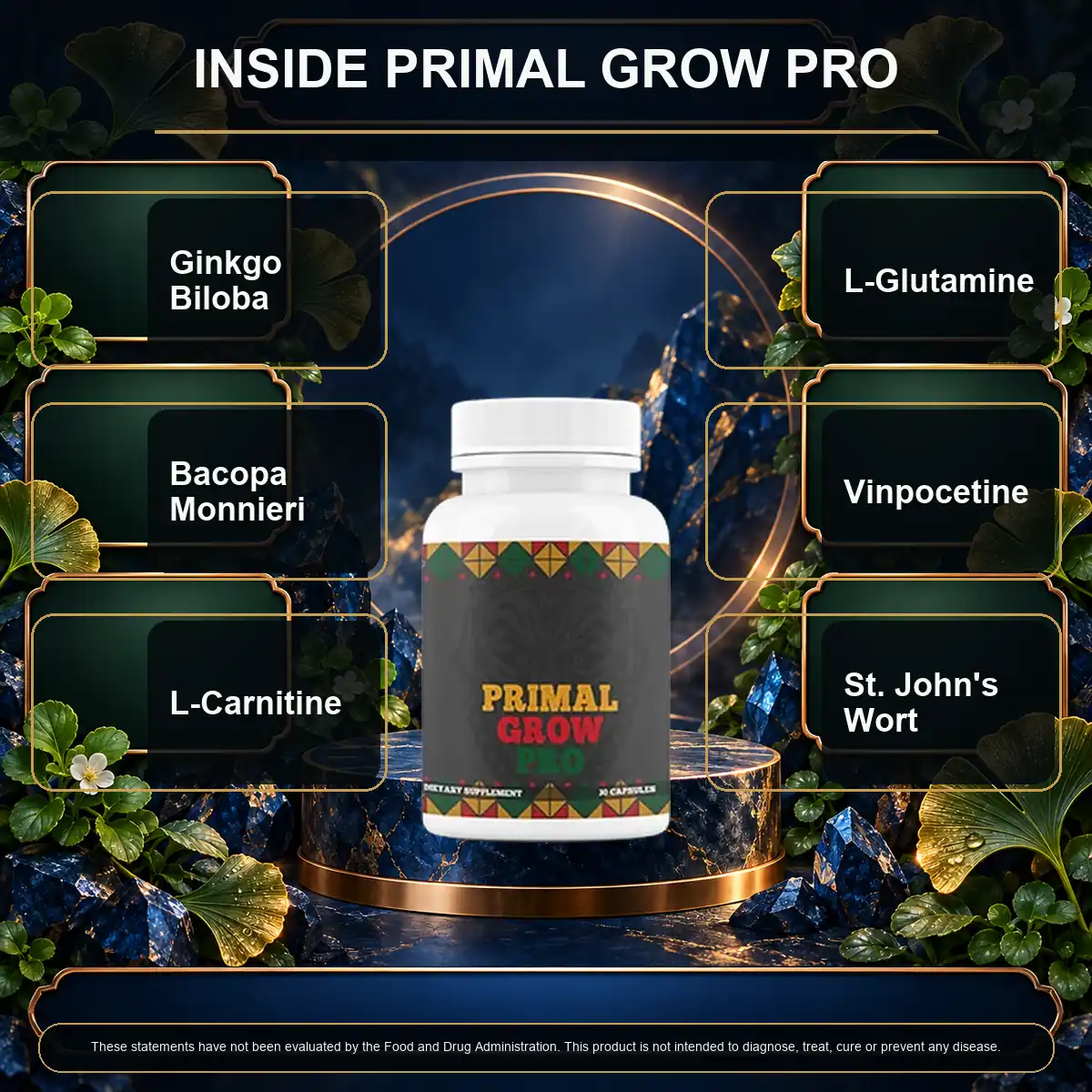
This is the image the seller uses to answer the ingredient question, and it is worth reading as a document rather than as decoration. Six names run down it. Beneath them sits the FDA disclaimer in full, which is the only piece of regulated text anywhere in the seller’s own artwork.
There are no amounts, no plant parts, no standardisation percentages and no other-ingredients line. There is also no caution panel, which is unusual for a formula containing St. John’s wort and is the single thing this desk would most like to see added.
It is reproduced here at the size it was supplied. Nothing has been cropped out of it and nothing has been added.
The companion image, headed HOW PRIMAL GROW PRO WORKS, carries the four routine steps rather than the ingredient list, and it is reproduced on how it works. Between them the two graphics are the whole of the seller’s published product information.
How to read a Primal Grow Pro ingredient name with no milligrams beside it
Four questions that get useful information out of an ingredient name even when no amount is attached to it.
Ask which part of the plant it is
Ginkgo is a leaf extract, St. John’s wort is the flowering tops, huperzine comes from a club moss and bacopa from the whole herb. The seller’s graphics give the plant and stop there. Plant part decides which trials apply, and it is the cheapest piece of information a label can carry.
Ask what it is standardised to
Every ginkgo trial worth the name used an extract prepared to fixed percentages of flavone glycosides and terpene lactones. Bacopa trials use extracts standardised to bacosides. A name with no standardisation attached is a botanical, not a preparation, and the research belongs to the preparation.
Ask what scale its research runs on
Micrograms for huperzine, milligrams for ginkgo, vinpocetine and bacopa, grams for carnitine and glutamine. Knowing the scale tells you which names could plausibly sit in a single capsule at a researched amount and which could not, even before a figure is published.
Ask whether the finished product has ever been tested
Seven names in one capsule is not seven trials. The evidence review of ingredients in popular male supplements looked for published randomised evidence on whole products in this category and found none. That is true of this capsule and of almost every competitor on the same shelf.
Those four questions are answerable in about two minutes from any label and any seller’s page, and they survive a change of brand. The companion piece on choosing a male vitality supplement turns them into a seven-point scorecard and then scores this product against it, failing rows included.
What is absent from the Primal Grow Pro ingredient information
What the label and the two graphics establish, set beside what they leave open.
On the Primal Grow Pro label and graphics
- Seven botanicals named, in two graphics the seller publishes
- A plant or compound identity for each one that can be looked up
- A capsule count on the bottle front, so the supply per bottle is fixed
- A category line, DIETARY SUPPLEMENT, setting the legal class
- The FDA disclaimer, printed in full on the ingredients graphic
- A lot reference and a certificate reference from the distributor
Left open by the Primal Grow Pro label and graphics
- A milligram figure for any of the seven, from any source
- The plant part or the standardisation behind each extract
- A capsule shell material, which decides the vegetarian question
- Any other-ingredients line: fillers, flow agents, colours
- An allergen statement, beyond what the roundels imply
- An order of inclusion, which on a real panel would rank the seven by weight
The right-hand column is the honest one and it is longer than the left. Six pieces of information that a compliant Supplement Facts panel would carry as a matter of course are simply absent from this product’s published material, and the first of them is the one that makes the other five hard to work around.
It is worth being precise about what that does and does not mean. It does not mean the capsule is empty, or that the seven names are fictional, or that anything illegal is happening: a great many supplements sell on a list with no panel behind it. It means a buyer cannot check this one against its own research, and neither can this desk.
The practical consequence runs through the rest of the website. It is why the timeline page refuses to predict a week, why the reviews page treats the distributor’s score as a summary rather than as evidence, and why the 60-day window is described here as the most concrete thing on offer.
Primal Grow Pro ingredient questions
How many ingredients are in Primal Grow Pro?
Seven are named, across two graphics that each carry six. The INSIDE graphic omits huperzine and the HOW IT WORKS graphic omits St. John’s wort, so the complete list is the union of the two. Whether the capsule holds anything beyond those seven, such as a flow agent or a shell material, is left open.
How much of each ingredient is in a Primal Grow Pro capsule?
The seller gives no figure for any of the seven, on the bottle, in either graphic or on its own pages. This website prints the amount each ingredient’s published trials used instead, and labels it as the trial’s figure every time it appears. Any per-capsule milligram number you find attributed to Primal Grow Pro came from somewhere other than the seller.
Is there a Supplement Facts panel on Primal Grow Pro?
No. Every product photograph in the asset pack is a front view, the front carries the wordmark, the category line, the capsule count and a decorative band, and the seller’s pages add no panel of their own. This website therefore has no supplement-facts page and reconstructs no panel, because inventing one would be worse than the gap.
Is the Primal Grow Pro capsule vegetarian?
The pack carries a vegetarian roundel and the label gives no shell material, so the roundel cannot be checked against anything. Most capsules of this type are either bovine gelatin or hypromellose, and the two are not interchangeable for anyone avoiding animal products. Testing and quality audits that roundel along with the other nine.
Does Primal Grow Pro contain a stimulant?
None of the seven named botanicals is a stimulant in the caffeine or synephrine sense. Huperzine acts on acetylcholine breakdown and vinpocetine on cerebral blood flow, neither of which is a stimulant mechanism. Since no full ingredient statement exists, this answer covers the seven names and cannot cover anything unnamed.
Which Primal Grow Pro ingredient should I look up first?
St. John’s wort, and not because of what it does for vitality. It induces two of the body’s main drug-handling systems and interacts with a long list of prescription medicines, hormonal contraceptives included. If you take a prescription of any kind, that one name settles whether this product is worth considering at all.
Sources behind the Primal Grow Pro ingredient page
Every study named above, grouped in the order the ingredient cards run.
- Ginkgo. In: LiverTox: Clinical and Research Information on Drug-Induced Liver Injury. Bethesda (MD): National Institute of Diabetes and Digestive and Kidney Diseases; 2012-. Bookshelf ID NBK548847. https://www.ncbi.nlm.nih.gov/books/NBK548847/
- Lopresti AL, Smith SJ. The effects of a Bacopa monnieri extract (Bacumen) on cognition, stress, and fatigue in healthy adults: a randomized, double-blind, placebo-controlled trial. Clin Drug Investig. 2025;45(12):967-982. PMID 41091332. https://pubmed.ncbi.nlm.nih.gov/41091332/
- Kongkeaw C, Dilokthornsakul P, Thanarangsarit P, et al. Meta-analysis of randomized controlled trials on cognitive effects of Bacopa monnieri extract. J Ethnopharmacol. 2014;151(1):528-35. PMID 24252493. https://pubmed.ncbi.nlm.nih.gov/24252493/
- Davani-Davari D, Karimzadeh I, Sagheb MM, et al. The renal safety of L-carnitine, L-arginine, and glutamine in athletes and bodybuilders. J Ren Nutr. 2019;29(3):221-234. PMID 30341034. https://pubmed.ncbi.nlm.nih.gov/30341034/
- Kuhn KS, Muscaritoli M, Wischmeyer P, et al. Glutamine as indispensable nutrient in oncology: experimental and clinical evidence. Eur J Nutr. 2010;49(4):197-210. PMID 19936817. https://pubmed.ncbi.nlm.nih.gov/19936817/
- Zhang YS, Li JD, Yan C. An update on vinpocetine: new discoveries and clinical implications. Eur J Pharmacol. 2018;819:30-34. PMID 29183836. https://pubmed.ncbi.nlm.nih.gov/29183836/
- Avula B, Chittiboyina AG, Sagi S, et al. Identification and quantification of vinpocetine and picamilon in dietary supplements sold in the United States. Drug Test Anal. 2016;8(3-4):334-43. PMID 26426301. https://pubmed.ncbi.nlm.nih.gov/26426301/
- Lecrubier Y, Clerc G, Didi R, et al. Efficacy of St. John's wort extract WS 5570 in major depression: a double-blind, placebo-controlled trial. Am J Psychiatry. 2002;159(8):1361-6. PMID 12153829. https://pubmed.ncbi.nlm.nih.gov/12153829/
- Crawford C, Wang YH, Avula B, et al. The scoop on brain health dietary supplement products containing huperzine A. Clin Toxicol (Phila). 2020;58(10):991-996. PMID 31990212. https://pubmed.ncbi.nlm.nih.gov/31990212/
- Kuchakulla M, Narasimman M, Soni Y, et al. A systematic review and evidence-based analysis of ingredients in popular male testosterone and erectile dysfunction supplements. Int J Impot Res. 2021;33(3):311-317. PMID 32358510. https://pubmed.ncbi.nlm.nih.gov/32358510/
Order Primal Grow Pro knowing exactly what the label says
Seven names, no published amounts, and this page prints the trial figure beside each one so you can see the gap for yourself before paying for anything.
Seven named botanicals · 30 capsules a bottle · 60-day money-back guarantee
Order Primal Grow Pro On The Official WebsiteLot PRI-26/PR-6751 · 30 capsules · taken once daily with food