Primal Grow Pro Official Website › How it works
How it worksHow Does Primal Grow Pro Work? The Ingredient Map
Primal Grow Pro works as a simple daily routine: one capsule with a meal, taken every day.
Circulation is linked to ginkgo and vinpocetine, mental sharpness to bacopa, huperzine and ginkgo, and energy to L-carnitine and L-glutamine.
Then read how to take it each day.
Four claimed supports, seven named ingredients, and the mapping the seller leaves out.
What the Primal Grow Pro routine graphic asks of you
The four steps the vendor graphic prints, transcribed, and what they cover.
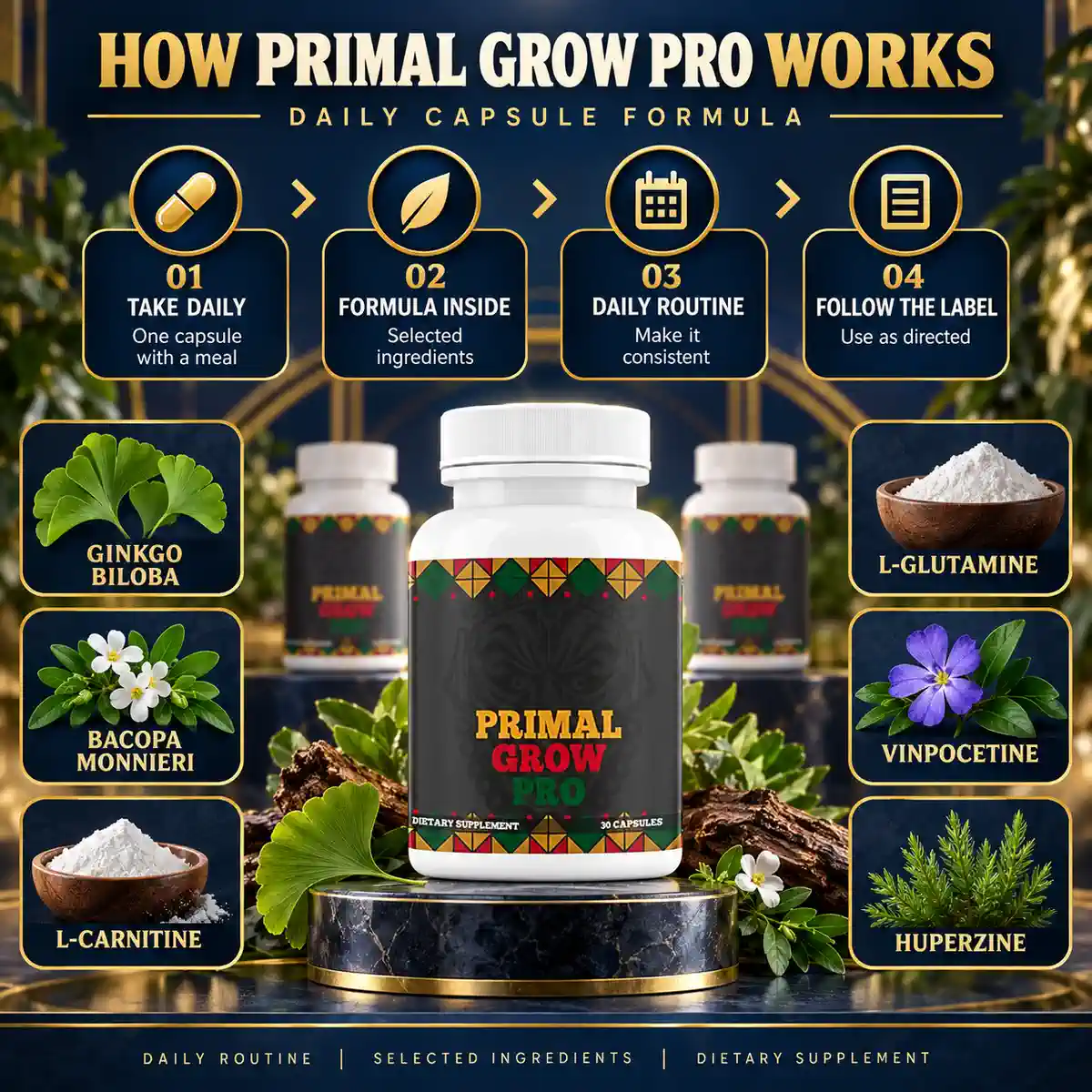
01 Take daily
One capsule with a meal
02 Formula inside
Selected ingredients
03 Daily routine
Make it consistent
04 Follow the label
Use as directed
Those four steps are transcribed from the seller’s own graphic, and they are about a routine rather than about a mechanism. Take one with a meal, keep taking it, follow the label. Nothing in them describes a pathway, and nothing in them promises a week.
That is a fair description of what the seller asks a buyer to do, and it is also the part of this product that is genuinely simple. A single capsule with breakfast is about as low-friction as a supplement routine gets, which matters more than it looks: the commonest reason a botanical never gets a fair test is that it stops being taken in week two.
What the graphic does not do is explain why any of the seven names is in there. The four sections below do that, one supposed pathway at a time, using the seller’s own list of supports as the map.
How the Primal Grow Pro names map onto the four supports the seller claims
Each of the four claimed supports, the names that would have to carry it, and what the literature on those names actually says.
| What the seller says it supports | The names that would carry it | What published work on those names shows |
|---|---|---|
| Circulation | Ginkgo biloba, vinpocetine | Ginkgo has been trialled for walking distance in intermittent claudication and vinpocetine for cerebral blood flow after stroke. Both are circulation questions; neither was asked about healthy men. |
| Mental sharpness | Bacopa monnieri, huperzine, ginkgo | The largest and longest trials sit in cognitive impairment and dementia populations rather than in healthy adults, and the modern reviews are cautious about all three. |
| Energy | L-carnitine, L-glutamine | Both are handled as nutrients rather than as botanicals. Carnitine moves fatty acids into the mitochondrion, glutamine is a fuel for gut and immune cells, and both are studied in grams. |
| Everyday male vitality | St. John’s wort, and the list as a whole | This is the vaguest of the four and the one with the least behind it. No published randomised trial exists on this finished product or on a combination resembling it. |
The middle column is this desk’s reading of which names would have to be doing the work. The seller does not assign ingredients to supports.
Four supports, seven names, and a mapping the seller never draws itself. The table above is an inference, clearly marked as one, and it is the honest way to answer “how does it work” for a formula whose own material never says.
The pattern in the right-hand column is worth naming. Three of the four supports have a research base that exists but was built in patients rather than in healthy men, and the fourth has essentially nothing. That is not unusual in this category: the systematic evidence review of male supplement ingredients reached the same conclusion across the best-selling products it examined.
Which leaves a reasonable question: what is a buyer actually getting? A daily routine built on seven plants and nutrients with long histories, at amounts nobody has published, backed by a 60-day return window. That is a smaller claim than the sales funnel makes and a more accurate one.
The circulation route in Primal Grow Pro, and how far it carries
Ginkgo and vinpocetine, the two circulation names, and the populations their trials were run in.
Ginkgo and vinpocetine are the two names with a circulation story, and they are told in different rooms of the same building. Ginkgo’s best-characterised effect is peripheral: the Cochrane review of ginkgo for intermittent claudication pooled fourteen trials in people whose leg circulation was measurably impaired and found the difference in pain-free walking distance small and of uncertain clinical importance.
Vinpocetine’s is cerebral. A 2022 meta-analysis in acute ischaemic stroke gathered the controlled trials and reported a signal on functional outcome alongside the usual warnings about study size and quality. That is a hospital question asked of a hospital population.
Neither trial programme was run in healthy men who felt their circulation could be better, and neither used a once-daily capsule of unstated strength. The gap between “this compound has circulation data” and “this capsule will change your circulation” is most of the distance in this category, and it is where most of the marketing lives.
The fair summary is that both names have a real place in the circulation literature, that the place is a clinical one, and that a capsule with no published amount cannot borrow the result.
- It is real research on real compounds, with published protocols and named journals.
- It was mostly run in people with a diagnosed circulatory problem.
- It used fixed daily amounts, usually split across the day rather than taken once.
- It says nothing about a seven-name capsule whose strength has never been published.
The mental sharpness route in Primal Grow Pro
Bacopa, huperzine and ginkgo, the three cognitive names, and what their own reviews concluded.
Three of the seven names, bacopa, huperzine and ginkgo, come from the cognitive literature rather than from anything to do with male vitality, and that is the clearest signal about how this formula was assembled. A 2026 network meta-analysis compared bacopa and ginkgo directly across the cognitive trials and found the measurable effect sat in the higher bacopa dose band, at 600 mg a day and above.
Huperzine A is a cholinesterase inhibitor, which is the same broad mechanism as several prescription dementia medicines, at a fraction of the potency. The Cochrane review in mild cognitive impairment found the trial base too small and too varied to support a recommendation. An earlier meta-analysis in Alzheimer’s disease reported benefits and said plainly that methodological quality was poor.
Ginkgo’s own headline result is the one that costs it most. The GEM trial gave 3,069 older adults 120 mg twice a day for a median of 6.1 years and did not reduce dementia incidence. That is the largest and longest test anyone has run on this plant, and a positive answer would have been very hard to miss.
None of that makes these names worthless. It does mean a buyer should expect something subtle rather than something obvious, should give it the eight weeks the timeline page sets out, and should not read a cognitive trial in a clinical population as a promise about their own week.
Every result above came from a fixed, published daily amount. Bacopa at 300 mg and up, ginkgo at 240 mg, huperzine in the hundreds of micrograms. A capsule holding seven ingredients cannot carry three of them at those amounts and still leave room for the other four. That arithmetic is worked through in full on the home page.
The energy route in Primal Grow Pro, and why it is measured in grams
Carnitine and glutamine, why their research runs in grams, and what the famous carnitine trial actually did.
L-carnitine and L-glutamine are the two names on this list that are not botanicals at all. Carnitine carries long-chain fatty acids across the mitochondrial membrane so they can be burned; glutamine is the most abundant free amino acid in blood and a preferred fuel for gut lining and immune cells. Both are in ordinary food and both are made in the body.
That changes what a supplement of either one can be expected to do. For a compound the body already synthesises and the diet already supplies, extra intake helps most where there is a shortfall and does progressively less where there is not. The review covering both in athletes treats carnitine up to 6,000 mg a day and glutamine in the tens of grams as the studied territory.
The male-vitality trial people cite for carnitine deserves its own sentence, because it is quoted a great deal and almost always loosely. Gentile and colleagues gave 2 g a day of propionyl-L-carnitine, a specific ester, to men with erectile dysfunction and diabetes, alongside prescription sildenafil taken twice a week. The carnitine was an adjunct to a medicine, not a substitute for one.
For this bottle the practical reading is modest: two nutrients, in a capsule too small to approach a gram of either, sitting alongside five botanicals. They are more likely to be there for the shape of the formula than for a dose effect, and nothing on this website suggests otherwise.
The one Primal Grow Pro name whose research has nothing to do with vitality
Where the St. John’s wort evidence actually sits, and why it is discussed here as well as on the safety page.
St. John’s wort is on this list and its research base is in depression. The Cochrane review gathered twenty-nine trials in 5,489 patients and found extracts performed better than placebo and comparably to standard antidepressants in those studies, with the trials from German-speaking countries reporting more favourable results than the rest. The large US trial, which allowed up to 1,500 mg a day, found no benefit in major depression.
There is no obvious male-vitality reading of that. What St. John’s wort brings to a combination formula is mood, and mood is a legitimate thing to want. What it also brings is the most consequential drug interaction profile of any botanical in common retail sale, which is why this website gives it a section of its own on side effects rather than a footnote here.
Two facts belong together and are best not separated. The trials that found an effect used 900 mg a day, split into three doses. The interaction effects are driven by the same constituents at similar intakes. A capsule with no published amount gives a buyer no way to place itself against either figure, in either direction.
Honest critique: what nobody can tell you about how Primal Grow Pro works
The limits on any answer to this question, stated once, in the section whose job it is.
Everything above is about the seven names. None of it is about this capsule, and the distinction is the whole of the honest answer to the question this page asks.
No randomised controlled trial of Primal Grow Pro exists. No assay of a Primal Grow Pro bottle by an independent laboratory has been published. No amount is available for any of the seven, so nobody outside the manufacturer can say whether a given name is present at a researched level, at a token level, or somewhere in between.
That is a real limit and it is worth stating in one place rather than hedging every sentence on the page. It does not make the product a fraud and it does not make the seven names meaningless. It means the honest description of the mechanism is: seven ingredients with published individual literature, combined at undisclosed amounts, in a product that has never itself been studied.
A buyer who finds that acceptable has a 60-day window to run their own test, which is the only experiment available here and is described step by step on how to take it.
Primal Grow Pro mechanism questions
How does Primal Grow Pro work?
The seller names four supports, everyday male vitality, circulation, energy and mental sharpness, and seven ingredients, without saying which name carries which support. Reading the literature on the seven, the circulation story belongs to ginkgo and vinpocetine, the sharpness story to bacopa, huperzine and ginkgo, and the energy story to carnitine and glutamine as nutrients.
Has Primal Grow Pro itself been tested in a clinical trial?
No published randomised trial of this finished product exists, and none exists for the great majority of products in this category. The research cited across this website is on the individual ingredients, at amounts the trials chose and this label does not state.
Is Primal Grow Pro a cognitive supplement or a male vitality supplement?
Its ingredient list reads as a cognitive formula. Bacopa, huperzine, ginkgo and vinpocetine are all names from the nootropic shelf, and mental sharpness is one of the four supports the seller claims. The vitality framing comes from the marketing around it rather than from the names.
Does Primal Grow Pro work like a prescription medicine?
No. It is a dietary supplement, it has not been approved for any medical use, and nothing in it is a substitute for a prescription. The one trial in the ingredient literature that touches erectile dysfunction gave carnitine alongside a prescription drug rather than instead of one.
Why does Primal Grow Pro contain St. John’s wort?
The seller does not say. Its own research base is in depression rather than in vitality, and mood is the most plausible reason for its inclusion. Whatever the reason, its interaction profile is the single most important fact on this website for anyone taking a prescription medicine.
How long before Primal Grow Pro does anything?
The distributor describes 4–8 weeks as the usual wait. The ingredient trials that measured anything ran for twelve weeks or longer, and the longest ran for six years. The timeline page sets both side by side.
Sources behind the Primal Grow Pro mechanism page
Each trial and review named above, in the order the pathways run.
- Nicolai SP, Kruidenier LM, Bendermacher BL, et al. Ginkgo biloba for intermittent claudication. Cochrane Database Syst Rev. 2013;2013(6):CD006888. PMID 23744597. https://pubmed.ncbi.nlm.nih.gov/23744597/
- DeKosky ST, Williamson JD, Fitzpatrick AL, et al. Ginkgo biloba for prevention of dementia: a randomized controlled trial. JAMA. 2008;300(19):2253-62. PMID 19017911. https://pubmed.ncbi.nlm.nih.gov/19017911/
- Tiemtad P, Ingkaninan K, Temkitthawon P, et al. Comparative effects of Bacopa monnieri and Ginkgo biloba on cognitive functions: a systematic review and network meta-analysis. Phytomedicine. 2026;153:157915. PMID 41678913. https://pubmed.ncbi.nlm.nih.gov/41678913/
- Yue J, Dong BR, Lin X, et al. Huperzine A for mild cognitive impairment. Cochrane Database Syst Rev. 2012;12(12):CD008827. PMID 23235666. https://pubmed.ncbi.nlm.nih.gov/23235666/
- Yang G, Wang Y, Tian J, et al. Huperzine A for Alzheimer's disease: a systematic review and meta-analysis of randomized clinical trials. PLoS One. 2013;8(9):e74916. PMID 24086396. https://pubmed.ncbi.nlm.nih.gov/24086396/
- Panda PK, Ramachandran A, Panda P, et al. Safety and efficacy of vinpocetine as a neuroprotective agent in acute ischemic stroke: a systematic review and meta-analysis. Neurocrit Care. 2022;37(1):314-325. PMID 35488169. https://pubmed.ncbi.nlm.nih.gov/35488169/
- Davani-Davari D, Karimzadeh I, Sagheb MM, et al. The renal safety of L-carnitine, L-arginine, and glutamine in athletes and bodybuilders. J Ren Nutr. 2019;29(3):221-234. PMID 30341034. https://pubmed.ncbi.nlm.nih.gov/30341034/
- Gentile V, Vicini P, Prigiotti G, et al. Preliminary observations on the use of propionyl-L-carnitine in combination with sildenafil in patients with erectile dysfunction and diabetes. Curr Med Res Opin. 2004;20(9):1377-84. PMID 15383186. https://pubmed.ncbi.nlm.nih.gov/15383186/
- Linde K, Berner MM, Kriston L. St John's wort for major depression. Cochrane Database Syst Rev. 2008;2008(4):CD000448. PMID 18843608. https://pubmed.ncbi.nlm.nih.gov/18843608/
- Davidson JR, Gadde KM, Fairbank JA, et al. Effect of Hypericum perforatum (St John's wort) in major depressive disorder: a randomized controlled trial. JAMA. 2002;287(14):1807-14. PMID 11939866. https://pubmed.ncbi.nlm.nih.gov/11939866/
- Kuchakulla M, Narasimman M, Soni Y, et al. A systematic review and evidence-based analysis of ingredients in popular male testosterone and erectile dysfunction supplements. Int J Impot Res. 2021;33(3):311-317. PMID 32358510. https://pubmed.ncbi.nlm.nih.gov/32358510/
Try Primal Grow Pro for yourself inside the window
Four claimed pathways, none of them tested on this finished capsule. The only experiment available is your own, and the window makes it reversible.
60 days from purchase · opened bottles included · 60-day money-back guarantee
Order Primal Grow Pro On The Official WebsiteLot PRI-26/PR-6751 · 30 capsules · taken once daily with food